Robotic Assisted MAKO Total Knee Replacement
Most total knee replacement operations involve replacing the joint surface at the end of your thigh bone (femur) and the joint surface at the top of your shin.
What is Robotic Assisted MAKO Total Knee Replacement?
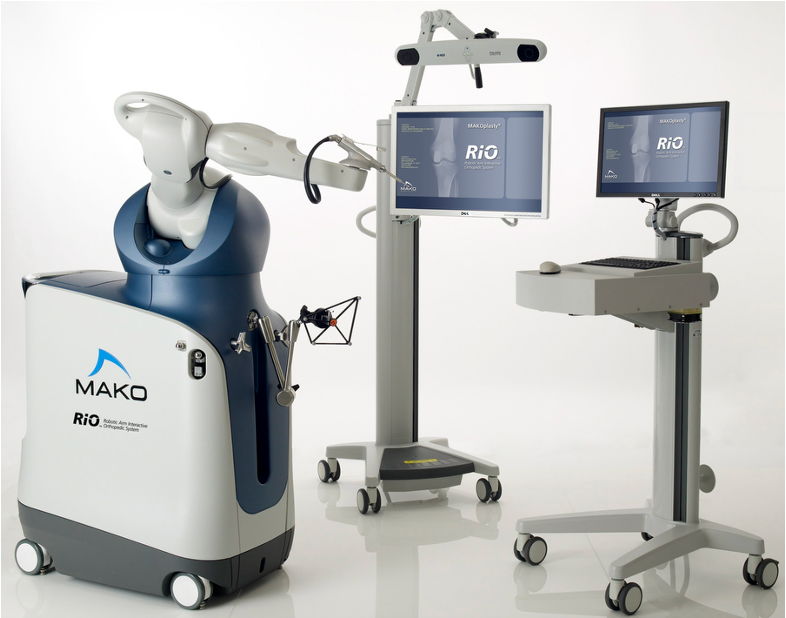
Recent advances in joint replacement surgery have led to the development of robotic assisted knee replacement techniques. In a conventional knee replacement surgery, the surgeon uses external jigs and a rod inserted into the thigh bone to place cutting jigs around the knee to perform the required bone cuts using a saw.
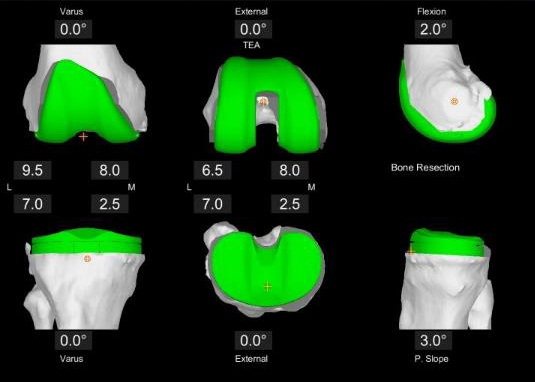
In a robotic assisted procedure, a pre-operative scan is performed of your knee and this allows a computerised 3D model of the bones to be used to plan the sizing and position of the implants before the surgical procedure is carried out and these are placed in the optimum position depending on the individual anatomy of your knee.
During the operation, tracker pins are placed into the thigh and shin bone temporarily to give real time information during the procedure and are removed at the end of your surgery. They allow information to be acquired on the optimum balancing of the knee replacement to maximise the knee movements and stability. The robotic arm is controlled by the surgeon throughout the operation and the bone cuts are carried out without the use of any external jigs using a saw in a very precise manner. This process is shown in the video of the bone cuts using the robotic arm during surgery.
Total knee replacements can be used to treat knee osteoarthritis affecting any or all the knee compartments. This is the most commonly performed type of knee replacement in the knee joint. During a total knee replacement the joint surfaces are replaced in all of the compartments and occasionally a polyethylene button is also used to replace the joint surface on the knee cap (patella). The total knee replacement implants are shown in the pictures.