Robotic Assisted MAKO Partial Knee Replacement
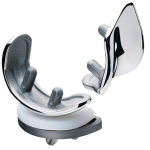
Most partial knee replacement operations involve replacing the joint surface at the end of your thigh bone (femur) and the joint surface at the top of your shin.
What is Robotic Assisted MAKO Partial Knee Replacement?
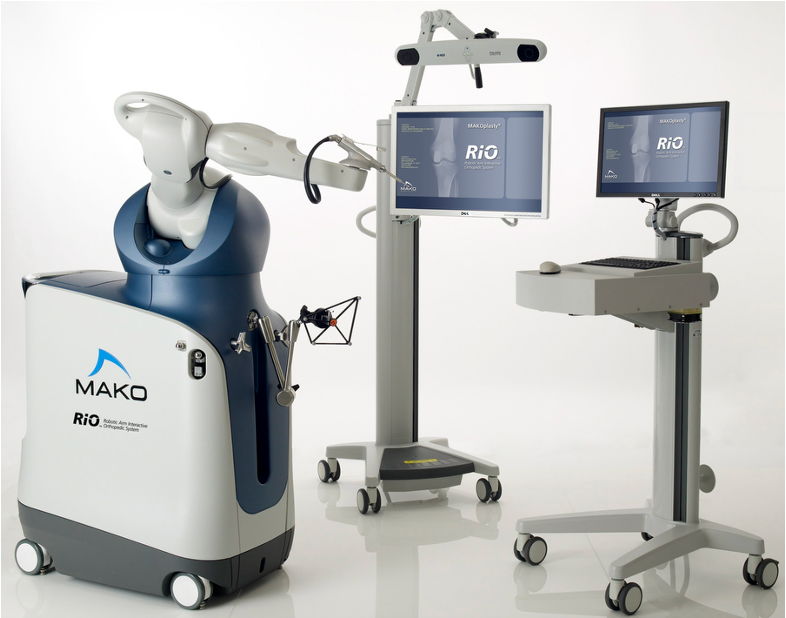
Recent advances in joint replacement surgery have led to the development of robotic assisted knee replacement techniques. In a conventional knee replacement surgery, the surgeon uses external jigs to place cutting jigs around the knee to perform the required bone cuts using a saw.
In a robotic assisted procedure, a pre-operative scan is performed of your knee and this allows a computerised 3D model of the bones to be used to plan the sizing and position of the implants before the surgical procedure is carried out and these are placed in the optimum position depending on the individual anatomy of your knee.
During the operation, tracker pins are placed into the thigh and shin bone temporarily to give real time information during the procedure and are removed at the end of your surgery. They allow information to be acquired on the optimum balancing of the knee replacement to maximise the knee movements and stability. The robotic arm is controlled by the surgeon throughout the operation and the bone cuts are carried out without the use of any external jigs using a saw and a burr instrument in a very precise manner.
Partial knee replacements are also referred to a half knee replacement or unicompartmental knee replacement. They most commonly are carried out to replace the media compartment of the knee on the inner side of the joint. They are being carried out with increasing frequency due to the advantages of only replacing the compartment in which the osteoarthritis is severe in the knee pain symptoms are localised to this area. Some of the advantages include a smaller scar, quicker post-operative recovery, less risks of surgery, a greater chance of a higher functioning knee and higher success rates.
Not all joint replacement surgeons perform partial knee replacements, but Mr Bell has a specialist interest in robotic assisted partial knee replacement procedures.
Mr Bell has been involved in clinical research for robotic assisted knee surely including a randomised controlled trial which identified improvement in the accuracy of the placement of robotic assisted partial knee replacement implant positioning (Improved accuracy of component positioning with robotic-assisted unicompartmental knee arthroplasty, Bell SW et al. Journal of the Bone and Joint Surgery America). Clinical studies for robotic surgery partial knee replacements have identified quicker recovery from surgery and less pain following the operation.
Partial knee replacements can also be performed in the outer half of the knee joint (lateral partial knee replacement) and the front of the knee joint (patellofemoral joint replacement).